
Indigenous Governance Database
IGD Database Search
The Structure of the Indian Act: Accountability in Governance
The Indian Act has been criticized for giving the Chief and Council too little power to make their own decisions. The Royal Commission on Aboriginal Peoples counted nearly 90 provisions that give the Minister of Indian Affairs powers over the Band and Band Council. But the Indian Act…

The Governance and Fiscal Environment of First Nations' Fiscal Intergovernmental Relations in Comparative Perspectives
This paper examines the Canadian Aboriginal fiscal inter-governmental system by comparing it to other countries, and also focuses on the key characteristics of the Canadian system. Over the last 20 years governments have decentralized power and responsibilities in response to an…
Seven Generations, Seven Teachings: Ending the Indian Act
Six generations have passed since the Indian Act was introduced and the seventh generation, now rising, will be healthier and our communities will enjoy more freedom if we assist them in getting rid of the Indian Act. Communities and the next generation can overcome the Indian Act’s hold over all…
The Jurisdiction of Inherent Right Aboriginal Governments
Since the recognition of Aboriginal and treaty rights in Canada by section 35(1) of the Constitution Act, 1982, the inherent right of the Aboriginal peoples to govern themselves has become a generally accepted aspect of Canadian constitutional law. But what is the scope of the…
The Crown's Constitutional Duty to Consult and Accomodate Aboriginal and Treaty Rights
The Crown’s duty to consult and accommodate Aboriginal and treaty rights is a fundamental matter of social justice that invokes very solemn legal obligations. Reconciliation and win-win situations can be achieved with good faith negotiations if the federal and provincial Crown immediately…
Colonial Fracture And Community Cohesion: Governance In The Stó:Lõ Community Of Shxw'õwhámél
This paper has three goals: 1) To briefly outline the process through which Shxw’õwhámél came to adopt the Siyá:m System in 1994; 2) to highlight certain concerns about the limitations of that system as articulated by community members in 2006; and 3) to provide a detailed discussion of those…
Indigenous Governance: Questioning the Status and the Possibilities for Reconciliation with Canada's Commitment to Aboriginal and Treaty Rights
Indigenous peoples have always had governance. This fact has been a matter of great debate among Canadian politicians and scholars for many years, but there is little doubt that Indigenous Nations had developed for themselves complex systems of government prior to colonization. The…
Indian Act Colonialism: A Century Of Dishonour, 1869-1969
In 1867, with the passage of the British North America Act, Canadians began the process of nation building. Over the next few years, new provinces emerged--Manitoba, British Columbia, Prince Edward Island--and Canada became, by 1873, a nation from sea to sea. At the same time, by way…
Aboriginal Nationhood and the Inherent Right to Self-Government
Canadian governments and courts recognize that pre-contact Aboriginal societies possessed their own legal and political systems and that to this day these nations have not surrendered the powers they fully exercised before colonial policies undercut their authority. …
Systems of Conflict Resolution Within First Nations Communities: Honouring The Elders, Honouring The Knowledge
First Nations people are well aware that many of our governments and citizens struggle to move beyond the violence and dysfunction that characterizes some individuals, families and communities. Within some community settings, drugs and alcohol prevail, family members are involved in…
Indigenous Justice: Clearing Space and Place for Indigenous Epistemologies
The realization of Self Determination for Indigenous Peoples is an exhilarating and fascinating movement that encourages human perseverance and an unfaltering belief in human potential and responsibility. It is a multi-dimensional movement that acknowledges and accepts human flaws…
First Nation Small Business and Entrepreneurship in Canada
There are thousands of Aboriginal organizations in Canada. They are owned, managed and staffed, wholly or in part, by First Nation (status and non-status Indian), Inuit, and Métis men, women, and youth. They exist in every region in the country where they perform profit, not-for…
Indigenous Leadership in a Flat World
The world is flat, so we are now told. In his recent book The World is Flat: A Brief History of the Twenty-First Century, Thomas Friedman argues that since the beginning of the Twentieth century globalization has evolved at an astronomically fast rate. As a result, the world is now…
Statement before the United States Senate Committee on Indian Affairs Oversight Hearing on Economic Development
Why is it that, amidst the well-documented and widespread poverty and social distress that characterize American Indian reservations overall, an increasing number of Native nations are breaking old patterns and building economies, social institutions, and political systems that work? What explains…
Customary Adoption Code, White Earth Band of Ojibwe
This code, developed by the White Earth Band of Ojibwe, allows adoption on the reservation for children but in a way that promotes cultural growth and support.
Constitutions and Economic Development: Evidence from the American Indian Nations
This paper presents an empirical examination of economic and institutional development. Utilizing a novel data set on American Indian tribal nations we investigate how constitutional design affects economic development, while holding the broader legal and political environment fixed. Instrumental…
White Earth Band of Ojibwe Child/Family Protection Code
The Child/Family Protection Code, drafted by the White Earth Band of Ojibwe for the purpose of protecting children and families from events of abuse, poverty, and separation.
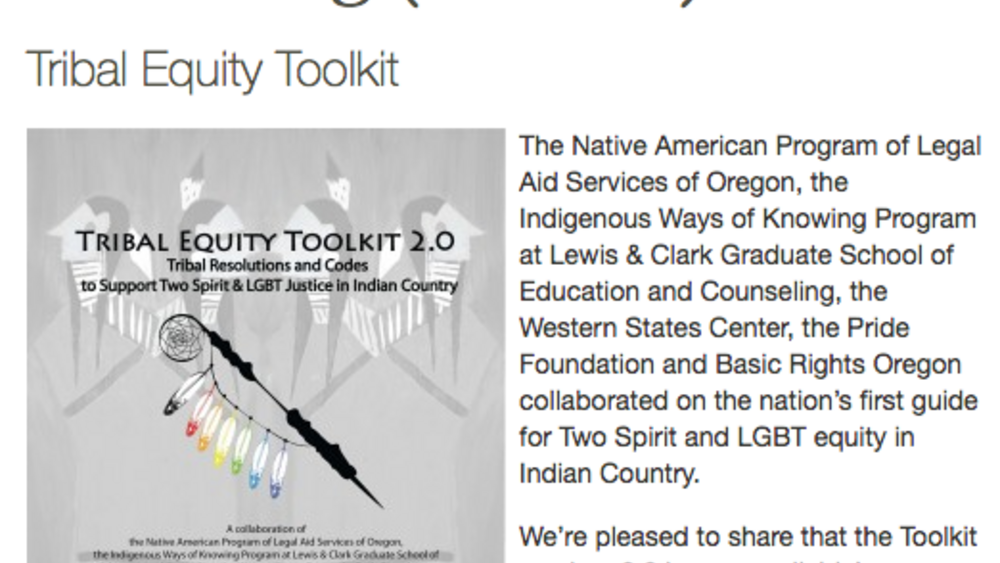
Tribal Equity Toolkit: Sample Tribal Resolutions and Codes to Support Two Spirit & LGBT Justice in Indian Country
This Toolkit has been developed to give tribal legislators a brief overview of legal and policy issues that impact the equal treatment of Two Spirit/ LGBT individuals. The Toolkit identifies areas in which existing laws discriminate against Two Spirit/ LGBT individuals, and offers sample resolution…
Good Practice Guide: Indigenous Peoples and Mining
It is important that companies take the time to properly understand the communities they work with including their particular context, concerns and aspirations. This Guide aims to assist companies to achieve those constructive relationships with Indigenous Peoples.
Legal Pluralism and Tribal Constitutions
What do pigs roaming the streets of New York City during the first half of the nineteenth century and tribal constitutions have in common? The most obvious (and often the most correct) answer is, undoubtedly, “absolutely nothing.” However, tribal advocates, particularly those concerned with the…