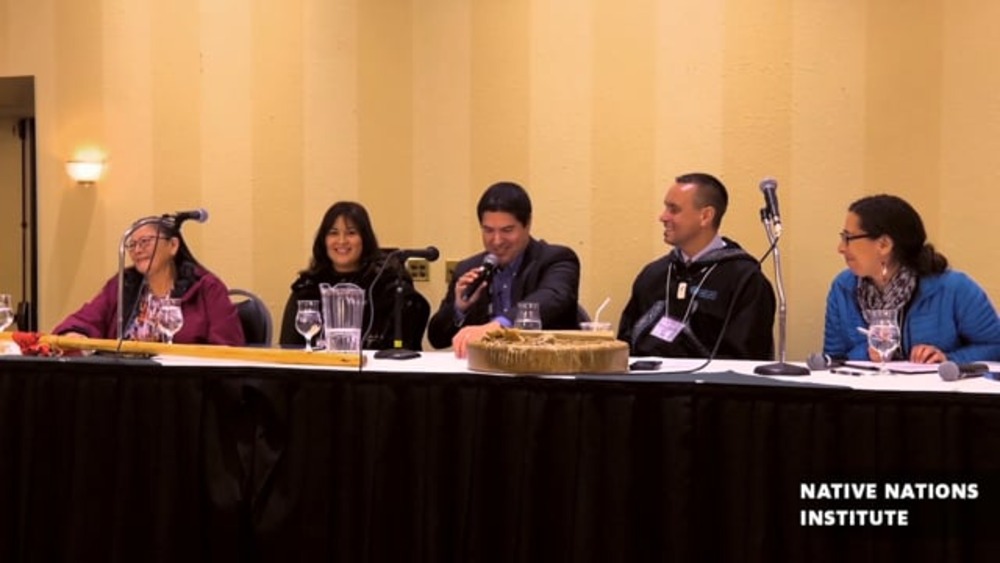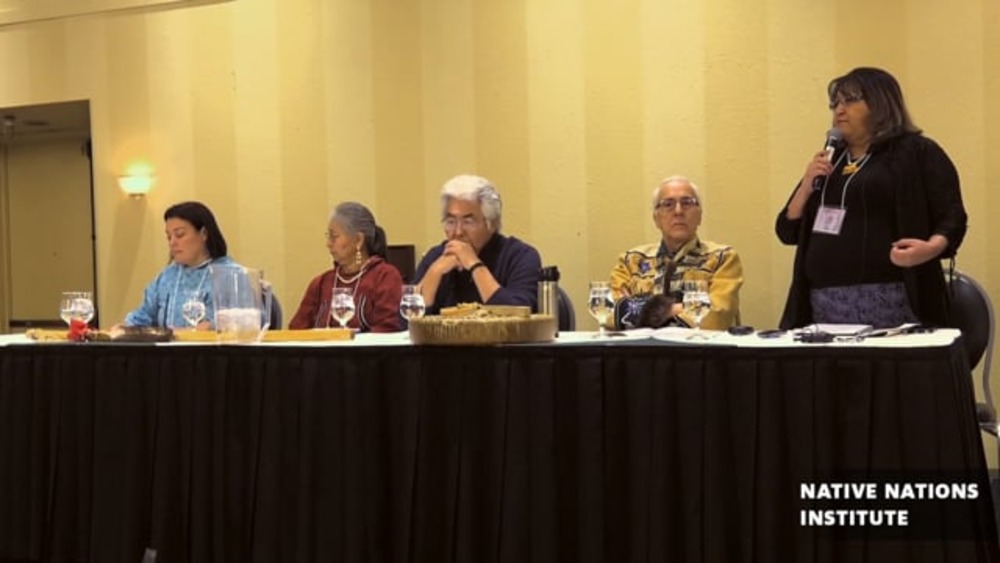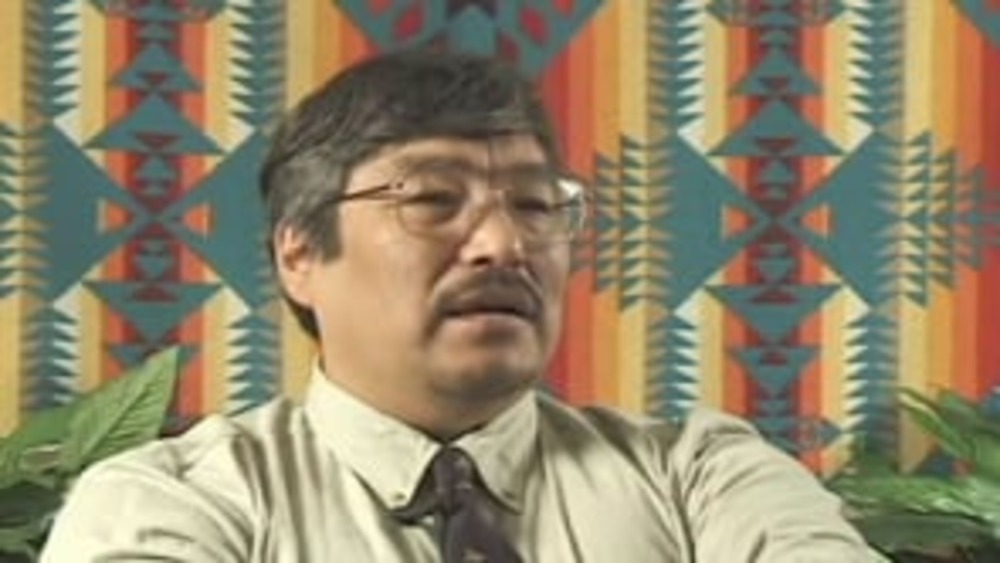
Wilson Justin is a cultural ambassador for Cheesh’na Tribal council and serves as a Vice Chair Board of Directors for Mt. Sanford Tribal Consortium. He relays his expertise and perspective on the intricacies of Indigenous governance in Alaska through adapting cultural traditions, creating a constitution, navigating citizenship, and asserting rights of Indigenous people.
Additional Information
Native Nations Institute. "Wilson Justin: Leadership with cultural knowledge and perseverance." Leading Native Nations, Native Nations Institute, University of Arizona, Tucson, AZ, November 15, 2016
Transcript
00:00:01:08 - 00:00:41:09
Welcome to Leading Native Nations. I'm your host, Danielle Hiraldo. On today's program, we are honored to have with us Wilson Justin, who currently serves as the culture ambassador for the Cheesh’na Tribal Council and has been a Tribal leader for more than 30 years. Previously, he served as the vice president and health director for the Mount Sanford Tribal Consortium and was responsible for staff development, program development, and negotiating the transfer of programs from the Cooper River Native Association
-Copper River Native Association to the Mount Sanford Tribal Consortium.
00:00:41:11 - 00:01:08:14
Mr. Justin has served in various capacities for Ahtna Inc. on the Alaska Native Corporation, including president, Operations manager, and community planner. Mr.. Mr.. Justin, welcome and thank you for joining us. I've shared some of your professional background, but please begin by telling us a little bit more about yourself.
00:01:08:16 - 00:01:48:06
Well, I'm Athabaskan. Althsetnay Athabaskan. Basically born and raised in the last of the traditional households in the home country. We came across, or we lived during the the time when the prospectors and the newcomers and the carpetbaggers hit Alaska between right after World War One to about 1965. So the cultural turmoil that occurred then, including the racism and all of that.
00:01:48:08 - 00:01:59:18
Basically, my background, I spent my whole life saying, I'm going to straighten this out one way or the other, but nobody told me it was going to take a dozen lifetimes.
00:01:59:20 - 00:02:35:21
Well, nation building is actually a relatively simple, straightforward concept. It's identity, language. The the the what you would call inherent authority to have your next generations come into the picture complete and whole, without being worried about colonizing, being colonized and having things imposed on them that they don't want. So nation building in its straightforward concept is pretty, pretty simple.
00:02:36:01 - 00:03:17:13
The problem is, most people look at nation building, not as nation building, but they look at it in a nationalistic fervor which brings ego into the question. Now, when you look at it from that standpoint, my nation is superior to your nation because we say things better. At that point in time, you lost the ability to look at nation building in terms of people's identity and the people's right to live and move into the section of who's got the right to make their way
00:03:17:15 - 00:03:43:01
imposed on all. The nation building, if you keep it simple and straightforward about a people being a people, you're okay. But that's not what we do in this day and age. It's always one-upmanship. Everybody talks about nation building nationalistically and that always fails the, that stops the discussion.
-So you talked a little bit about the challenges of nation building.
00:03:43:01 - 00:03:48:13
But what do nation building leaders do?
00:03:48:15 - 00:04:27:11
- Well I don't want to sound condescending or perhaps a bit negative, but let's not forget the fact that nation building is is a Western concept imposed on the idea of what the process should be about. If you say, what do nation builders do? You leave out the issue of what's the role of cultural bearers, tradition, storytellers and clans in nation building?
00:04:27:12 - 00:05:07:10
They’re absolutely a vital concept within the issue of retaining, building nations. But the question of what do nation builders do brings the question back into the ego fold. I am me, I am the greatest. And that's precisely what nation builders try to get away from. It's not about me. It's about us and the next generation. The nation building is all about transferring a unique, specific set of knowledge from one point to the next point without interruption.
00:05:07:12 - 00:05:40:19
Where we are today is in the middle of this great interruption and very criminal interruption in my in my, my perspective, because it's all about eradication. So nation building is going from point A to point B with a set of knowledge intact. And that's what I try to do.
- What were the specific or separate roles and responsibilities that were traditionally held by the clans, by the youth or the elders, or how how did that look
00:05:40:20 - 00:05:52:16
traditionally, within your community?
- We got a week? Maybe ten days? But part of the
00:05:52:18 - 00:06:26:20
traditional role and responsibility, or a lot of it actually was swept, swept under, aside and put underground by churches and military activity, and what you would call traders, people who own post office. The eradication and destruction of traditional roles and responsibility and governmental functions began actually with a dispute over the standing of medicine people. In our country,
00:06:26:21 - 00:07:02:22
medicine people were part and parcel of the trade trails, and they enforced the what you would call the local economic base, meaning they set the price for things that move through. Now, chiefs who were not a part of the trade trail got their cut no matter what. So if you came to a traditional chief territory and the medicine people operated on the edges of it along the trade trail, they would ensure that a certain percentage of the goods were left for the chief.
00:07:02:24 - 00:07:34:12
So the destruction or the eradication of the identity began on an economic base. It was reinforced by the church by demonizing medicine people, saying that they were voodoo artists and voodoo people, things like that. The Trading Post had a superior, or you might say a large, the largest interest in that they needed to take the ability to manage the market away from the traditional medicine people and put it in the hands of the trading posts.
00:07:34:14 - 00:08:04:12
The military also needed to be able to move the issue of who controlled access, and who controlled trails and byways away from the medicine people and the chiefs into the military's hands. Everyone had a vested interest in taking down traditional roles and responsibilities. So when you say what were the traditional roles and responsibilities, the question diverts itself away from the answer.
00:08:04:14 - 00:08:44:06
What you should be saying is, “What roles and responsibilities that were so important that they survived the cultural eradication process?” That I can speak to.
- That was my next question. Thank you.
- That's where it's supposed to start.
- That was actually my next question. So how much of that remains today?
- When I was... I'm of that age where I caught the the last of what you would call the traditional family settings, the traditional headman role, the family councils, the great uncles and the uncles.
00:08:44:08 - 00:09:18:02
And I caught the last of what we would call the oratory style. The speakers, the ones who were in charge of Potlatches, what have you. So there are four fundamental traditional roles in, in, in the society. And these were all pretty much gone by the time I was 12 to 14 years old. The first one was what we would call the headman or the primary speaker for the village or the community.
00:09:18:04 - 00:09:46:02
Generally, that person was the senior uncle, the clan speaker, and that person usually had 2 or 3 dialects, so that because of intermarriages, all the marriages up until my generation were arranged. So your arranged marriages involved two separate and distinct clan dialects. So the senior speaker or the headman for the village, or the community, or the clan gathering place needed to be bilingual.
00:09:46:03 - 00:10:16:11
Several dialects, sometimes four, sometimes three. That was your first position. Nowadays they call them chiefs, but it had, when I was growing up with the term chief had no meaning. What they talked about was (Athabaskan word) which is the the headman. And (Athabaskan word) was kind of a borrowed Russian term in itself, meaning a powerful, important person, generally somebody that was capable of doing several potlatches.
00:10:16:13 - 00:10:46:21
So we use that term for a person of prestige and stature. We kind of co-opted, but we had another term which was more traditional, which meant the the person, the person who make things happen. That traditional term was more a what you would call a local band leader, a specific band leader. He would have a specific number of followers, whereas the (Athabascan word) would have to deal with several clans, several dialects.
00:10:46:22 - 00:11:00:17
That was number one. Number two, when I was growing up was the the the uncle, the uncle who was in charge of remembering all the stories.
00:11:00:19 - 00:11:32:16
The senior uncle of the village would be the historian. He would track all of the traditional stories. He would be the one that would tell people what the times of the year when certain stories were told. Like, for instance, in December we we had the sacred story cycles. So the senior uncle, the clan uncle, not my uncle, not your uncle or his uncle, but the Clan Uncle was the senior story keeper.
00:11:32:18 - 00:11:57:19
His function is like my function today, which is the cultural bearer. So his job was to explain to other clans that in a given time ... how the story meshes. Because the stories would be different. And that avoided interpretive conflicts. So we had a very important, very prestigious job. And one of the things he did was to ensure that potlatch protocols were observed.
00:11:57:21 - 00:12:25:07
So this person was very important. There, again, the confusion comes into being. A lot of times that person would refer to as chief [laughs] can remember ... these people drove me nuts. Not not not my people, but the white guys. They just drove me nuts with all this Chiefs this, Chiefs that and Chief over there. And the third person was really what you would call the head of the family.
00:12:25:09 - 00:12:57:17
So you would have 3 or 4 different families, but the oldest of the firstborns would be like the head of the family. They would be oftentimes they would be kind of adopted by the entire clan So this oldest, I'm the oldest, would be a repository of a lot of information. You would be told stories that were not told to other of your family.
00:12:57:19 - 00:13:28:14
You would be given descriptive geographic information about boundaries, trails, rivers, lakes. Who's over here in terms of the boundaries over across the range, downriver. So you would get real broad geographical knowledge and background of things, events, and historical context. We didn't have a name for that person, but they were widely recognized and utilized by the traditional clan system as spokesmen.
00:13:28:15 - 00:13:54:23
They're the ones who went down and talked to the Russians -- if you weren't killing Russians, you were talking to them -- or elsewhere. There again, here we come again with the English descendants. This guy, the chief. Nothing to do with being a chief at the specific role, a specific place, specific time to function. So half the times of the year, he's off doing things, you know, for his family.
00:13:54:23 - 00:14:27:05
The other half, the time he's doing what you're supposed to be doing on behalf of the clan or the tribe. But that never made him a chief. He's still the senior uncle of that, or that headman of that family. The fourth, and not the last, but basically the only one that was left functioning when I was growing up was what we would refer to today as a counselor. Kind of a
00:14:27:07 - 00:15:00:11
very wise, neutral person who who would... people would go to to seek advice on disputes, conflicts, things like that. Today you would refer to them as kind of a judge. There, again, because people accorded prestige and stature, that individual, here comes the Europeans again, “That must be a chief.” So every one of these positions were separate, unique, and completely absent of each other's overlap.
00:15:00:11 - 00:15:22:19
But every one of those positions were called “chiefs” by the white men. So here I am, getting raised in this, the last of the... of these things, and I'm going to school and thinking, this is a crazy, crazy, crazy, crazy world. How is it going? to...How will it ever operate? Well, I asked myself that question when I was 15.
00:15:22:21 - 00:15:47:11
How is this world going to ever operate? And I'm the age I am now. And the answer is it can't. It can't work. It hasn’t. It's very clearly shown that it can't work. You have to have order, structure, understanding. And no matter how complex the situation is, you have to have rules uniquely suited and prepared for those complexities.
00:15:47:13 - 00:16:27:22
That's what we were all about.
- How are the Cheesh’na Tribal Council roles and responsibilities currently divided?
- Basically, the the the Cheesh’na Tribal government. Now, a little bit of history. Most of the small tribes in Alaska under attack in the 70s and 80s and dismissed as being non-entities, operated on a very limited basis, primarily in the traditional sense, generally working with their own people and or using the Bureau of Indian Affairs generated constitutional model.
00:16:27:24 - 00:16:47:21
It was only in the last, I'd say, the late mid 80s, that small tribes, like Cheesh’na that I'm familiar with, began exercising powers. The problem is, nobody could agree on what those powers are.
00:16:47:23 - 00:17:12:16
We knew, or we could presume to know that we had jurisdiction over a wide variety of actions. But there was nothing in the rulebook that says, “okay, here, here and here. Not there. Not there. Not there.” Nothing like that. It was all this one giant blank wall, and you just kind of had to bump your head against things before you figured out where you should be and what you should do.
00:17:12:17 - 00:17:46:12
So this modern day Cheesh’na Tribal government is made up of individuals who came of age in the 80s and 90s and their outlook in terms of nation building or government, and a lot of them are my cousins, are predicated upon the issue now of, ‘He who takes the first action suffers the most.’ [laughs] And that's being adopted by a lot of tribes.
00:17:46:13 - 00:18:27:07
So the wait-and-see attitude is slowly beginning to be a major issue in small government. And you have to remember, no small government has the expertise, money, time or reason to be constantly challenging everybody about the extent of jurisdiction. That's why the state can get away with basically, in my estimation, breaking a lot of laws that have to do with self-determination. Because a small tribe doesn't have the means or the or the wherewithal to to challenge the state.
00:18:27:08 - 00:18:54:07
- So you bring up a really good point. Can you tell me a little bit about the or describe the Mount Sanford Tribal Consortium? Because that's two federally recognized tribes.
- Well, the Sanford Tribal Consortium is not a federally recognized tribe. It's a function of what we call title five legislation. Title five legislation was produced by Congress in the mid 90s, maybe early 90s.
00:18:54:08 - 00:19:26:02
It was designed to provide a template for the assumption of health service from the Indian Health Service. In other words, title five allowed a tribe to to negotiate and contract with Indian Health Service for the assumption of health services provided by the Indian Health Service. So the transfer and the relocation of all those funds and sources through IHS to the tribe is what title five is all about.
00:19:26:04 - 00:19:57:02
Now, Cheesh’na has a title, is what you would call a traditional government, has the same authority with the Bureau of Indian Affairs under 638, but there was no legislative process for the assumption of health dollars and medical expertise from IHS to tribes. So title five was created to try out... model a process that might work with the tribe. We got into it
00:19:57:02 - 00:20:24:23
not long after the legislation was passed, the Mount Sanford Tribal Consortium. Interestingly enough, a lot of other organizations like Copper River Native Association all throughout the state were grandfathered in so they didn't have to worry about title five legislative processes as we did. But we formed under title five, became very successful and operate a clinic.
00:20:24:24 - 00:20:43:04
Dental health, a lot of activities in the home country, very successful for us.
- Have there been any challenges in working in such a consortium?
- I do not remember a single day without challenge in the entire process. [laughs]
00:20:43:06 - 00:20:55:06
That's like asking if you had any problem trying to evict a bear out of his cave, or what he perceived as his cave. It was tough. [laughs]
00:20:55:08 - 00:21:22:04
I, I could write a book on how challenging it was.
- I think in order for our viewers to know what's going on with Tribal governments up here, they would have to understand a little bit about the Alaska Native Claims Settlement Act. Can you just maybe briefly describe that and your perspective of how that is either helped or hindered Tribal governments today?
00:21:22:06 - 00:21:51:17
- Well, you want the paranoid conspiracy view, or the the guy that fell asleep at the beginning, or [laughs]? There’s like a dozen different perspectives on this thing. You pick anyone you want. They're all valid to a certain degree. And I was part of, I shouldn't say I was a part of the Alaska Native Claims... I was there during the development of the Alaska Native Claims Settlement Act, but I was one of those who was opposed to the act itself.
00:21:51:18 - 00:22:20:10
I just considered it a a big resource-extraction bill. I never thought of it as Indian legislation. Now, that was not a very popular standpoint. It kind of put you into the realm of being a renegade, a rebel, or, you know, the common terminology during those days was troublemaker. So my take on the Alaska Native Claims Settlement Act hasn't changed much.
00:22:20:11 - 00:22:43:16
It was never meant for Indians. Never meant for Yupiks, or Iñupiats, or Aleuts. It was meant to get oil across the state of Alaska to Valdez, which it did very well. Was it good? Well, as far as economic platforms, yes, it did a lot. But the key item to remember with the Alaska Native Claims Settlement Act, that was in section four
00:22:43:17 - 00:23:39:01
it took away traditional rights, jurisdiction and authority, which undermined self-determination and a whole bunch of other laws that had been promised to be effective in terms of tribes and Alaska Natives. So the section of the Alaska Native Claims Settlement Act, section four, that undermine our identity and our standing, is a sore point today. And I'm not going to go into to it extensively, but I will say that during the spring of 1971, the the version of the ANCSA legislative language that was proposed that I saw that was about March, or about April or May, that I saw did not have section four. The version that was passed in December 18th, 1971, did.
00:23:39:04 - 00:23:53:05
So that's the little tagline about conspiracy. We all know the legislative process. We all know the give and take. We all know people do what they have to do under the...
00:23:53:07 - 00:24:20:23
times that were in place. I know one thing. If I were a part of that process in Washington -- and there was a reason why I wasn't. People like me aren't allowed to be in those processes because we think the way we do. But if I was there, I would have never been able to reconcile section four in ANCSA on the basis of it being a part of ANCSA. It would have to be exempt.
00:24:21:00 - 00:24:53:24
All that said, I can't criticize the Alaska Native Claim Settlement Act as a Tribal leader simply because it turned the state of Alaska into an anti-, or I should say, it made the state of Alaska cognizant that we have to be... that *they* had to be allies with the Native population one way or the other, no matter how much animosity there is on a personal and village and Tribal level.
00:24:54:01 - 00:25:23:23
That greater story is that the economic power of the regional corporations are beginning to turn the winds in our favor, and have been. So, I can't criticize the long-term outcome. I can and have criticized ANCSA and regional corporations for being what I would call too conservative. They have to wait until everything is in place. Everybody likes everything.
00:25:24:00 - 00:26:03:05
Then they'll get into the act. Like, for instance, this issue of what I call navigational servitude, which is a very well known legal term predicated upon the Supreme Court decision for the Western water states, 1953, I believe. Here in Alaska, that battle was lost by the Ahtna Regional Corporation in 1987. Navigational servitude is the platform that the state uses to determine issues like management of salmon access.
00:26:03:07 - 00:26:08:20
There's a whole host of reasons why
00:26:08:22 - 00:26:35:06
navigational servitude should be first and foremost on everybody's mind, including food security, including water quality, including climate change. And yet the state has navigational servitude due to what I would refer to as misapplied legal principles, and they were never challenged. When Ahtna lost the case in the Ninth Circuit, Ahtna did not take it to the next level, which is the Supreme Court.
00:26:35:06 - 00:27:10:02
But the problem back then was that nobody recognized navigability as an important issue. Now every regional corporation, including village corporation and Tribal governments, in 1987 should have been involved in that lawsuit. It was that important. But it was like a rowboat disappearing in the horizon on the ocean. Nobody noticed it was gone until 30 years later. Now we're in a big uproar about food security and salmon and access and trespass.
00:27:10:02 - 00:27:58:21
But the battle was lost then. And that's what I'm talking about when I say the delayed reaction has always been a headache for me, because recognizing something happened 30 years after the fact kind of makes things tough to deal with.
- Tell me a little bit about the events that led to the Cheesh’na Tribal Council adopting a written constitution.
- Well, in part, we had a we had a previous council that had come completely apart due to factionalism, fights over over jobs and fights over the question of the distribution of resources.
00:27:58:23 - 00:28:14:11
There was very little money coming in, primarily through the BIA and 638. So the question of the 1 or 2 jobs was extremely important. That meant that a family would be secure, and there was a decade-long battle
00:28:14:13 - 00:28:38:07
in the Tribal Council that ended about 1982, about over the question of the issue of who would get the jobs and how the money would be used within the village. So beginning about 1983, ‘84, the new council, the one who came in to pick up the pieces, took care of things, said, we got to have a little order in the house.
00:28:38:08 - 00:29:06:11
We got to have a way to resolve things. We just can't go down, take the ship down fighting every time we disagree. So there was some search about what might be valuable. And the BIA had developed a template. So that template was fiddled with a bit. And it was fairly, I mean it for that time, that place during the 80s, it was good.
00:29:06:12 - 00:29:38:12
It was all... but by the by the time the early 90s came, came around that template, that model had served its purpose, served its function. Now it needs to be updated. You have new shareholders, new Tribal members. You have equal issues, a whole host of issues that rarely was an issue back then. So, the crisis management process was what brought Cheesh’na to the point of adopting a constitution.
00:29:38:12 - 00:30:03:20
And I think that's fairly true everywhere, is that things got to blow up first before you realize you got to have a way of settling things.
- So have there been any amendments to the Constitution?
- Well, actually, on... we rewrote the Constitution, redrafted it totally to reflect the more modern times. It has not been adopted yet by the constituency.
- Has the...
00:30:03:21 - 00:30:34:01
Did the rewrite occur recently?
- Oh, the rewrite was probably about five years ago.
- And has it been proposed to the constituency or the citizens?
- I believe twice.
- And has failed?
- Well, what you need is a special meeting for the... you have to have a certain number of people show up, and you have to have people who have looked at the Constitution and can speak to it.
00:30:34:02 - 00:31:06:13
And I expect that this coming year, 2017, is when we'll wrap up the push to have a new constitution adopted. There is portions of the Constitution that looks specifically at the identity of the Tribal government. For instance, we name the plans that were originally the formative, the, the, the plans that were there to start the village back in the 30s and 40s.
00:31:06:15 - 00:31:53:24
We also took a look at some of the other jurisdictional pieces that we needed in order to proceed on OCS cases, the ability to intervene. We looked at some of the functions of Constitution in terms of peace, security, consent. Also, we looked at the question of the blood quantum, descendance, which I spoke about yesterday. In our estimation, a true, true government has to be able to determine the citizens in terms of not only who they are, what they are, but how long down into the next generations will your citizenship extend?
00:31:54:03 - 00:32:20:18
And that's a very, to me, that's such a serious question. And yet we don't, we tend to shy away from it, because that brings into this issue of marriages between Natives and non-Natives. That brings into the question of what do you do with a complete, complete non-Native child that you adopt or want adopt? You can answer those questions in a properly written constitution.
00:32:20:20 - 00:32:57:05
You have the inherent authority to determine your citizenship. But most constitutions are all about Indians being Indians because that's what drives the service allocation. For instance, the BIA service dollars, I think you have to be one-quarter Indian. IHS is 1/8th or 1/16th. So the blood quantum issue comes up constantly. And blood quantum issues are predicated upon the question of whether or not you're going to be able to be eligible for federal dollars for services.
00:32:57:07 - 00:33:25:17
That's a pretty sad way to run a government or a nation. The nation is supposed to be interested in doing the right thing for its citizens 24/7. And that means you better be able to know what your citizens are.
- In the lower 48, we hear that citizenship is a very contentious subject, especially when we're talking about blood quantum, just like you said, that there's dollars or services attached to that.
00:33:25:17 - 00:33:55:02
And people who, some people have a vested interest in maintaining that status quo. Do you see any type of pushback or did you, when you were doing this rewrite and reconsidering identity for the Cheesh’na Tribal council and the Tribal government? Did you see any pushback on that blood quantum, or reconsidering what it means to be a member or a citizen of the community?
00:33:55:04 - 00:34:17:16
- Well, all the people under 50 got mad about it. They said, “Who are you to talk about blood quantum?” Well, the short answer is that you can't operate a nation unless you talk about these things. All the older people understood instinctively that these things need to be dealt with, but there are a lot more young people than older people, believe me.
00:34:17:21 - 00:34:41:14
And they're louder. But but the simple but the simple fact is you can't function as a nation or a government unless you deal with the citizenship issues. And that's where we started from. And if people get mad, people get mad. It's not our business to make people mad, but it is our business to deal with things that do make people mad.
00:34:41:15 - 00:35:04:17
- Do you mind talking a little bit about the process of writing the Constitution? I'm assuming that there was a committee or some people together formed as a group to sit down and say, “This is what we think instinctively about who we are and how we want to govern.”
- Well, in a small tribe, it's not a question of a process as so much as it is crisis management.
00:35:04:20 - 00:35:37:16
A lot of times, those portions of our, of our Constitution that we brought into being were a direct response to failures of its existing system, particularly in OCS and ICWA. So our Constitution was predicated upon responding to crises that we had no control over. And if I had to do it all over again, I would have at the beginning said, “Let's not have a constitution that’s silent on crises because then you're going to have to patch one together as you go along.”
00:35:37:17 - 00:36:04:01
It's better to sit down with a committee of the whole tribe and say, “What's your worst fears? Your worst fears? Losing your child? Okay, put that up. Number one. Losing your job. Put that up. Not being able to hunt and fish. Put that up.” Sit down and list all of your fears of your Tribal members, and then write your constitution to address those fears.
00:36:04:02 - 00:36:10:04
That's what I would have done. But hindsight, like I said yesterday, is 20/20. [laughs]
00:36:10:05 - 00:36:28:10
I wasn't that smart 30 years ago.
- How do you incorporate the youth with such a high young population within the Tribal government?
- Extremely difficult. One of the one of the.
00:36:28:12 - 00:37:01:07
One of the things that made me really want to leave the stuff that I do is the inability of dealing with youth. When I was growing up, you know, my uncles, my aunts all took a direct, immediate, everyday interest in what I was doing, where I was, and the connectivity was right there. I'm an alcoholic and alcoholism is the supreme state of being
00:37:01:08 - 00:37:27:11
for alcoholics. In order for me to be able to walk away from alcohol, it was that existing structure and that connectivity. I drew strength from the... constantly disappointing my uncles and my aunts in my actions, which gave me the ability to get past my drinking. We don't have that kind of a connectivity with our youth today. It's parallel.
00:37:27:13 - 00:37:52:15
They have their silos over here, we have our silos over here, and we have windows where we look to see if anybody's over there every once in a while. It's been the supreme disappointment of my life that we weren't able to hold on to that connectivity. Now, that's not tribe's fault. That's the constitutional issue of individual liberty, confidentiality.
00:37:52:17 - 00:37:57:18
There was a lot of children that were,
00:37:57:20 - 00:38:38:15
I would say, taken into captivity by OCS in the bad days of extensive drug and alcohol issues. Uncles, aunts, grandparents were all barred from getting involved because of the... what the agencies would refer to as the right of confidentiality. That alone was the single most destructive piece of institutional law that almost brought down the Indian nations. That thing about confidentiality and individuality.
00:38:38:17 - 00:39:08:19
Tribe, I never considered myself as an individual. I won't even introduce myself on stage using my name because I was told when I was growing up, someday you speak for us, but you don't speak for you. Now you won't find me running around and say who I am and have no name tag. We have a Tribal protocol that says you can't put somebody else's decoration over your heart.
00:39:08:21 - 00:39:35:22
Yours come first. So in order for me to to put on a name tag, simple thing like that, I would have to have that my position regalia, my clan band, my speakers necklace. Then I'll put on the white man's name tag. Well, I don't have any of that. So no white man's name tag. Simple things like that just seems not to be able to get people's attention on everyday sense.
00:39:35:22 - 00:40:07:21
So when you have that sense of individuality in your youth, from the day they were born, all the way up until the time they go through school and they become young, young adults, the the ability to have them step out of their silos and you step out of their silos is extraordinarily tough. And it's been a lifelong issue with me.
00:40:07:23 - 00:40:21:13
- You talked about the four fundamental roles and responsibilities traditionally. How were the leaders chosen during that time? Based on clan, family?
00:40:21:15 - 00:40:42:12
- Oh, I knew that was going to come up.
- And then, in addition. how were they held accountable?
- I've answered many, many different times, but these are very long, complex subject. I'm going to start out by saying that.
00:40:42:14 - 00:40:59:19
The epidemics and there was about 15 to 18 of them, began coming into the region from sometime in the 1700s. The first responders were the medicine people and the chiefs, and they began dying.
00:40:59:21 - 00:41:29:00
About 20 or 30 years before contact, before the first white man came into our region, the process of desolation and destruction had been going on for half of a generation. Extensive starvation and what have you. So all of our traditional, our traditional society, as a functioning governmental society stopped and got parked.
00:41:29:02 - 00:41:34:11
Fast forward all the way up into the
00:41:34:13 - 00:41:58:14
modern era. Once we got past the failure, starvation and the issue of who we are and what we were. Which brings us into the, my era, the late 40s, early 50s, these traditional hierarchical
00:41:58:16 - 00:42:12:19
leadership quotients began to come out of the off the shelf, so to speak, except they were now subject to the limitations of English.
00:42:12:21 - 00:42:50:12
When we started bringing back our traditional system, it came back in this broken English form. Like I said about the issue with chiefs, everything was a chief, no matter what. So when we began rebuilding the traditional society, we had parallel systems. We had the English version, which everybody suffered but went along with. Then we had the traditional system, which was primarily a function of small, isolated clans.
00:42:50:14 - 00:43:23:09
The more isolated and inured and cushioned against the modern day imposition of values, the more likely you were of keeping or having your direct access to your stories, your culture, and everything necessary to understand these roles and responsibilities and responsibilities. In a traditional leadership sense. It's just like that young lady that was there talking about her
00:43:23:11 - 00:44:00:11
wish to go home again. The same thing happened between 1750 and 1950. Everybody who was a part of the those 200 year-long destruction of a culture and a tradition, know and understood you can't go home again. But everyone said we will find a way to live now, like we would have liked to have lived back then, with the limitations imposed on us now.
00:44:00:13 - 00:44:34:06
So most of the traditional leadership positions today were tweaked to accommodate the 22nd century. Now you have a chief in terms of English that has broad authority and jurisdictional application. Then you have council presidents who have constitutional authority given to them by the Constitution, and you have cultural bearers and standard bearers like myself, who draws upon tradition, traditional values that parallel but don't overlap with the other two.
00:44:34:08 - 00:45:06:07
You're not going to be able to make sense of it all until we finally sit down and say, do we want to bring all of our traditional values back, good or bad? That's my remarks about yesterday, about getting friendly with your history. In my country, we were a very warlike nation prior to the epidemics we were feared. We didn't have any problems with going around bonking people.
00:45:06:09 - 00:45:33:03
Do you want... Our, the Ahtna Nation was predicated upon strength and power. Do you want to bring that back as part of your traditional leadership values? That's a conscientious decision that needs to be made by the governments that are in place now. So the Tribal governments have the wherewithal, inherent authority to say, this is the kind of people we want to be.
00:45:33:05 - 00:45:59:12
What they have to do is learn to ask the cultural bearers like me. What do you think will fit in the best way? Today, in 2016, on down to 2035? Were perfectly willing to answer. But do we want to make laws? No. We just want to have a quality of life get better as time goes by. And the identity, people should be proud of who they are.
00:45:59:13 - 00:46:22:01
They should be able to speak their language. My great grandsons should have a wide variety of choices of language to learn. That should be their decision, not mine. I shouldn't be in a position of saying, you can only be our citizen if you speak our language. What if they wanted to learn their uncle’s language or their mom’s language?
00:46:22:03 - 00:46:51:04
So we don't want to be put in the position of being enforcers of a system that is more or less put together by what you would call stops and starts for 200 years. All we want to do is ensure that the citizenship qualities be agreeable to all and be, you know, equal. It's an equity thing, and we want to ensure it goes down a long ways in the generations to come.
00:46:51:06 - 00:47:14:10
So other than that, I really don't give a hoot about, I don't I'm not interested in being involved in making laws, giving laws or defining laws or anything like that, but I'd be willing to help.
- Is there any interaction between, like you, for instance, as the cultural ambassador, some of the elders within the community, and the the elected leadership?
00:47:14:14 - 00:47:47:05
Is there any interaction of, I don't want to say checks and balances because that's so Western, but just do you talk? I know you talk, but...
- Any time I want I could go see anybody I want on any subject. That's a privilege. And it's something that I don't abuse. So I have access, which is denied to many, many, many parts of our society.
00:47:47:07 - 00:48:17:13
So not only do I have access, but people wouldn't dare not give me the time, but I don't abuse that privilege. So that's one part of the answer, the other part of of interaction or that's your term. My my term would be, “Whose turn is it to speak?” We have a kind of a functioning... We remember how it used to be that no one cannot be heard.
00:48:17:15 - 00:48:26:13
Now that brings up an interesting complexity that you don't hear in these things, but which is a part of nation building.
00:48:26:15 - 00:48:45:03
In our traditional system, for instance, injustice, let's say, let's say that you and I are man and wife. We have a traditional arranged marriage. And let's say I've harmed you by some action.
00:48:45:05 - 00:49:02:18
Once the conflict develops in the American system, you you're always going to be the one who face your accusers, and you're going to have your day in court. In our traditional system,
00:49:02:20 - 00:49:32:19
your senior aunt, your mother's oldest sister, would represent you. My mom's oldest brother, the senior uncle, would represent me. We would not be allowed, you and I would not be allowed to sit there and argue and yell at each other and scream about all the things. You would be taken back to your clan. I would go back to my clan, and senior uncle and aunt would say, “This is what the problem is.
00:49:32:24 - 00:50:06:01
Now we have to talk about settlement.” So today when you talk about the issue of interacting, it's against our protocols and our governance to have individual interaction. Someone speaks for you, but also you are never unheard, except it would not be between us. You would tell your story complete to your aunt. Your aunt, your senior aunt, would tell it back to your mom.
00:50:06:01 - 00:50:29:24
You're not going to tell your mom. You're going to tell your aunt, your aunt going to tell your mom. Your mom is going to tell your husband. Your husband's going to tell his uncle, the uncles and the aunt. At some point in time when everybody is in agreement on what the story is, then they'll meet. In the meantime, you and I might not have seen each other for two years, but I could never bring your name up in my side of the family.
00:50:30:01 - 00:51:03:05
And you can't do that on your side. The ones who do that are the senior uncle. That's the original counsel that is referred to now in governance in Indian Country. That's the beginning of the way councils operated. But it was predicated upon 100% confession. I have to... I have to say specifically and expressively that I confess to my interactions against you, because if I don't do that, I will not be representative.
00:51:03:07 - 00:51:39:03
So that's the way our system worked. So the idea of me interacting with somebody at any given time is a very complex privilege that survived these 200 years of death, destruction and what have you. So in today's society, that kind of complexity is hard to understand. And you don't hear it over here, but it should be remembered. That's what drives Alaska tribes and clans at the small, or the smaller government levels.
00:51:39:05 - 00:52:09:15
I’ve done literally hundreds of these interviews. The one question that really doesn't spend much time in a daylight, so to speak, is you'll hear me off and on, say, “An Indian knows how far is too far. An Indian knows how much is too much. An Indian knows how little is too little.”
- I heard you say that yesterday.
00:52:09:16 - 00:52:49:09
Yes.
- No one ever says what's the underlying causative platform that produces that kind of knowledge? Nobody ever says that. So in the future, you find another culture bearer, you might want to talk about that, but I'll give you a short example. It begins with our... our governance is taught to us when we're young through sacred storytelling. We know how far is too far because of the way our stories are constructed for our benefit and told to us by our storytellers.
00:52:49:14 - 00:53:17:20
Our governance begins with these traditional stories told to us with all these lessons built into the stories. You hear him a hundred times. By the time you're 15 years of age and you're ready to enter into a marriage arrangement, the governance structure is embedded in your thought process. And it's impossible not to... It's impossible for an Indian to, to act like a non-Indian.
00:53:17:22 - 00:53:40:05
I couldn't be a white man for all the tea in China and all the threats of torture in the world, and it's that easy. But I never hear anybody say what makes an Indian an Indian that he knows all of this stuff?
- In our stories and our songs.
- It starts with our stories, and our songs are predicated upon the permission and consent.
00:53:40:07 - 00:54:15:20
The core principle of being Indian is permission and consent. The white man gives himself permission, takes consent because he has permission. Indian Indians say we have to have permission to be here. Creator creates permission. Consent comes from his, the creator's subjects. So when I go to hunt moose, I wait for the the first ones to come. If the chickadees, the chickadees will sing that singing is permission.
00:54:15:20 - 00:54:42:20
That's when my. I know I'm okay to go hunting. What I'm going to hunt the moose is going to send me consent for losing his life. The consent bird is the Blue Jays. He'll come and and dance and laugh around the cabin. Then I know I have permission to go hunting from the creator. And I have consent to take that moose’s life from the moose himself.
00:54:42:20 - 00:55:01:18
I can't give myself consent to shoot the moose. The moose has to send a message of consent through a friend, and that would be the bluejay. So permission and consent are woven into the fabric of our thought processes. It's impossible to get away from it once you're into it.